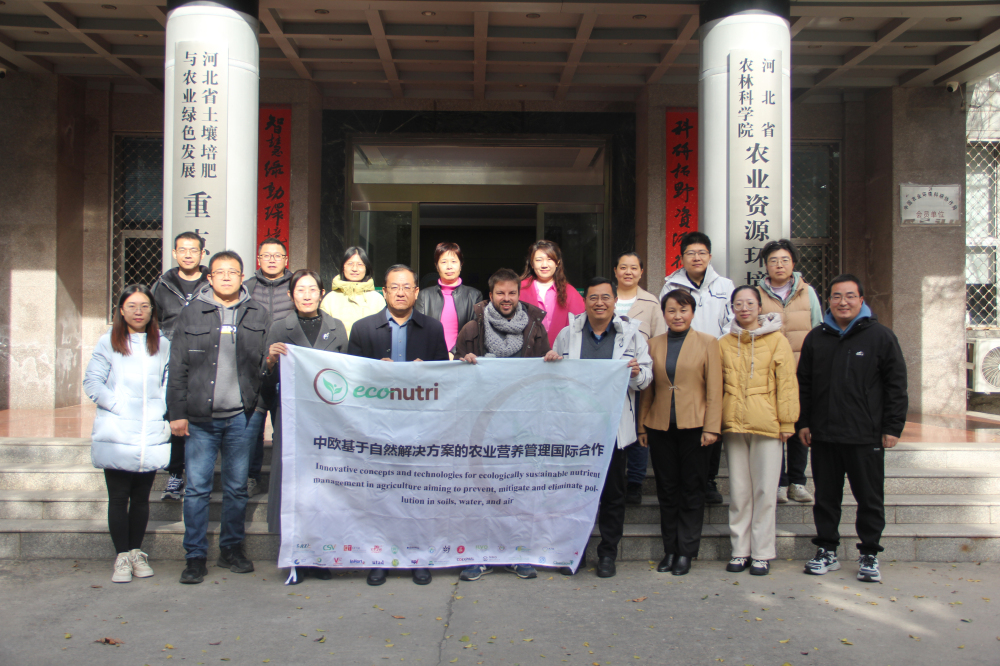
From November 17th to 18th, 2025, Professor Rodney Thompson from the University of Almeria and Associate Professor Guillermo Guardia from the Polytechnic University of Madrid in Spain were invited to visit the Institute of Agricultural Resources and Environment, HAAFS. Academic exchange activities with themes such as N2O reduction in crop systems, improvement of nitrogen utilization efficiency (NUE), crop models, and intelligent decision support systems for water and fertilizer (DSS) were carried out, aiming to deepen research and cooperation between the two sides in the field of agricultural water and fertilizer management and promote the optimization and innovation of agricultural nitrogen cycle management.
Associate Professor Guardia delivered an academic report titled "Mitigation of N2O emissions and reactive nitrogen in Mediterranean agro-ecosystems", systematically introducing the key processes of the nitrogen cycle in the Mediterranean agricultural ecosystem in Spain, with a focus on sharing the research achievements of his team in reducing N2O emissions in crop systems, improving nitrogen use efficiency (NUE), and reducing the loss of reactive nitrogen (Nr). Professor Rodney elaborated on the application of DSS (Intelligent Decision Support System for Water and Fertilizer) in various countries around the world and made prospects for future research directions. Both sides had an in-depth discussion on technical difficulties such as the development of the DSS system, model optimization, and database management, and explored how to optimize agricultural nitrogen cycle management through system integration to enhance precise fertilization and water resource utilization efficiency.


Subsequently, they were invited to visit the positioning experiment of facility vegetables and the lab-scale hydrothermal carbonization equipment, further deepening the understanding of the core issues of agricultural nitrogen cycle management. Both sides also reached a consensus on the formulation of subsequent field optimization plans, providing new research ideas for precision agriculture.
This event focuses on N2O reduction, NUE optimization and the application of DSS systems, providing new ideas for promoting the efficient and sustainable development of agriculture in the context of climate change. In the future, both sides will continue to enhance communication and cooperation, especially in the development of DSS systems, research on N2O reduction technologies, and optimization of agricultural nitrogen cycle management.
Through this academic exchange, the Institute of Agricultural Resources and Environment, HAAFS has taken an important step forward in the research and cooperation with Spanish institutions in the field of agricultural water and fertilizer management, providing valuable experience and support for future research and practice in areas such as nitrogen cycle management and precision agriculture.
(Source from www.hebnky.com)