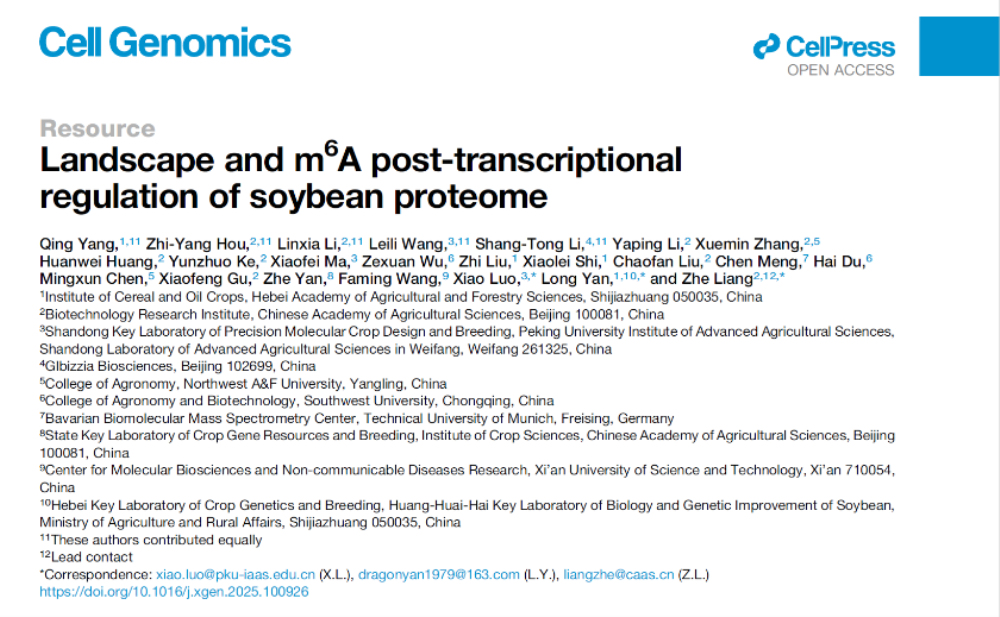
Recently, the Institute of Cereal and Oil Crops of HAAFS, in collaboration with the Institute of Biotechnology of the Chinese Academy of Agricultural Sciences, the Institute of Modern Agriculture of Peking University, and Beijing Glbizzia Biosciences Co., Ltd. and other institutions, published a cover article in Cell Genomics, a sub-journal of Cell. The title of the paper is “Landscape and m6A post-transcriptional regulation of soybean proteome”. This study used the main promoted variety ‘Jidou 17’ in the Huanghuai Region as the material to map a quantitative proteome landscape for soybean, revealed the role of RNA methylation in regulating the expression level of soybean protein, and based on proteome data, mined a new gene MTBa that regulates m6A and soybean development.

In this study, 4D-DIA-MS technology was used to quantitatively analyze 12,855 proteins in 14 soybean organs, completing the most extensive transcriptomic-level identification and quantitative mapping of RNA methylation m6A modification in 14 soybean organs to date. Through the correlation analysis between the protein level and the transcriptional level, it was found that the correlation of proteins among different tissues was higher than that of transcripts, and a large number of genes did not show a significant correlation between the transcriptional and protein level. In addition, this study comprehensively analyzed the quantitative N6-methyladenosine (m6A) in soybean tissues. m6A was demonstrated to play a significant role in the inconsistency between RNA and protein level in soybean and was positively correlated with RNA expression in soybean, which was consistent with the role of m6A in Arabidopsis thaliana but contrary to the results in rice.
In addition, through the analysis of the soybean proteome landscape and m6A methylome data, this study found that MTBa is a new participant required for m6A methylation in soybean. Three homozygous MTBa mutant lines were obtained through CRISPR-Cas9 technology. The Dot-Blot test results showed that compared with the wild type, the m6A level of the three MTBa mutant lines were significantly decreased, and the plant height during reproductive growth and maturity was significantly reduced. These results not only indicate that GmMTBa is a key m6A regulator in soybean development, but also suggest that the proteomic data from this study can help identify new genes in soybeans..

In summary, this study has mapped the first panoramic quantitative proteome landscape of soybean to date and conducted a synchronous quantitative analysis on the transcriptome, m6A modification and proteome of the same batch of samples, systematically clarifying the regulatory role of m6A modification on the protein level. The breakthrough lies in advancing the multi-omics research of soybean to the proteomic level. By exploring the regulatory role of m6A in the transcriptional and post-transcriptional stages, it reveals the mechanism by which protein expression levels are simultaneously influenced by both transcriptional and post-transcriptional modifications. The proteomics data generated in this study provide valuable resources for identifying new genes and studying soybean biology at the protein level, and also open up new ideas for intelligent design breeding of soybean based on multi-omics data.

Link of this paper: https://doi.org/10.1016/j.xgen.2025.100926
(Source from www.hebnky.com)